• Works
  • PORTFOLIO
  • About
  • Writing
  • CONTACT
Menu

Stephen RG Bennett

  • Works
  • PORTFOLIO
  • About
  • Writing
  • CONTACT

SIGN UP FOR NEWSLETTER HERE

Interspecies collaboration with Tomas Saraceno

April 25, 2022

This is the third blog on my Clore Fellowship/Wellcome Trust sponsored study visit to the USA. See the others here.

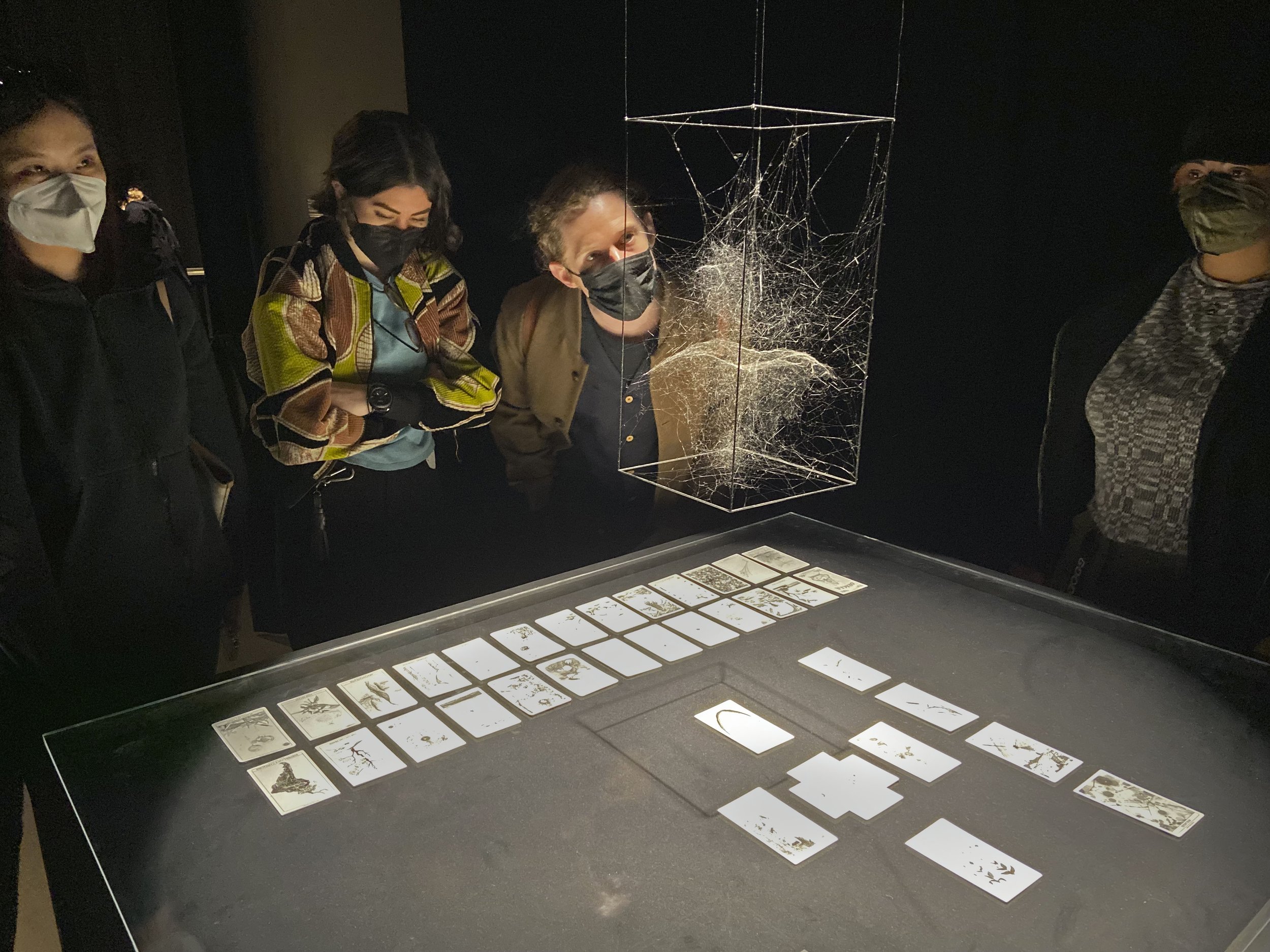
Upon the recommendation of Melanie Crean I managed to catch the last day of Particulate Matter(s) by Tomas Saraceno at the Shed. The stand out theme was interspecies co-creation of artwork for the show. Seven or eight sealed glass tanks contained the webby results of collaboration between Saraceno and various arachnids (top image). 

The webs were skilfully up-lit to display the engineering - and possibly artistic - prowess of their eight-legged makers. Some tanks were populated by the webs of 5-10 spiders, including different species in some cases; some had fewer, whilst one striking web was the creation of a single Nephila Senegalese (second image).

One could be churlish and argue there was an asymmetry of power and consent between the collaborators; the exhibition blurb described it as a dialogue, which is a nice way of putting it (see image of blurb). It is probably more important to focus on the impending threat to arachnids and many other species, from the Capitalocene, defined in the show as ‘the current era of earth’s existence characterised by the destructive effect of capitalism on the environment’. There were an interesting set of ‘oracle’ cards, I think playing to the belief in some cultures of spiders as truth-tellers or diviners. They reminded me of a well-crafted evidence discovery - but with a giant tank of spiders’ webs placed in the middle of the table (see fourth and fifth images).

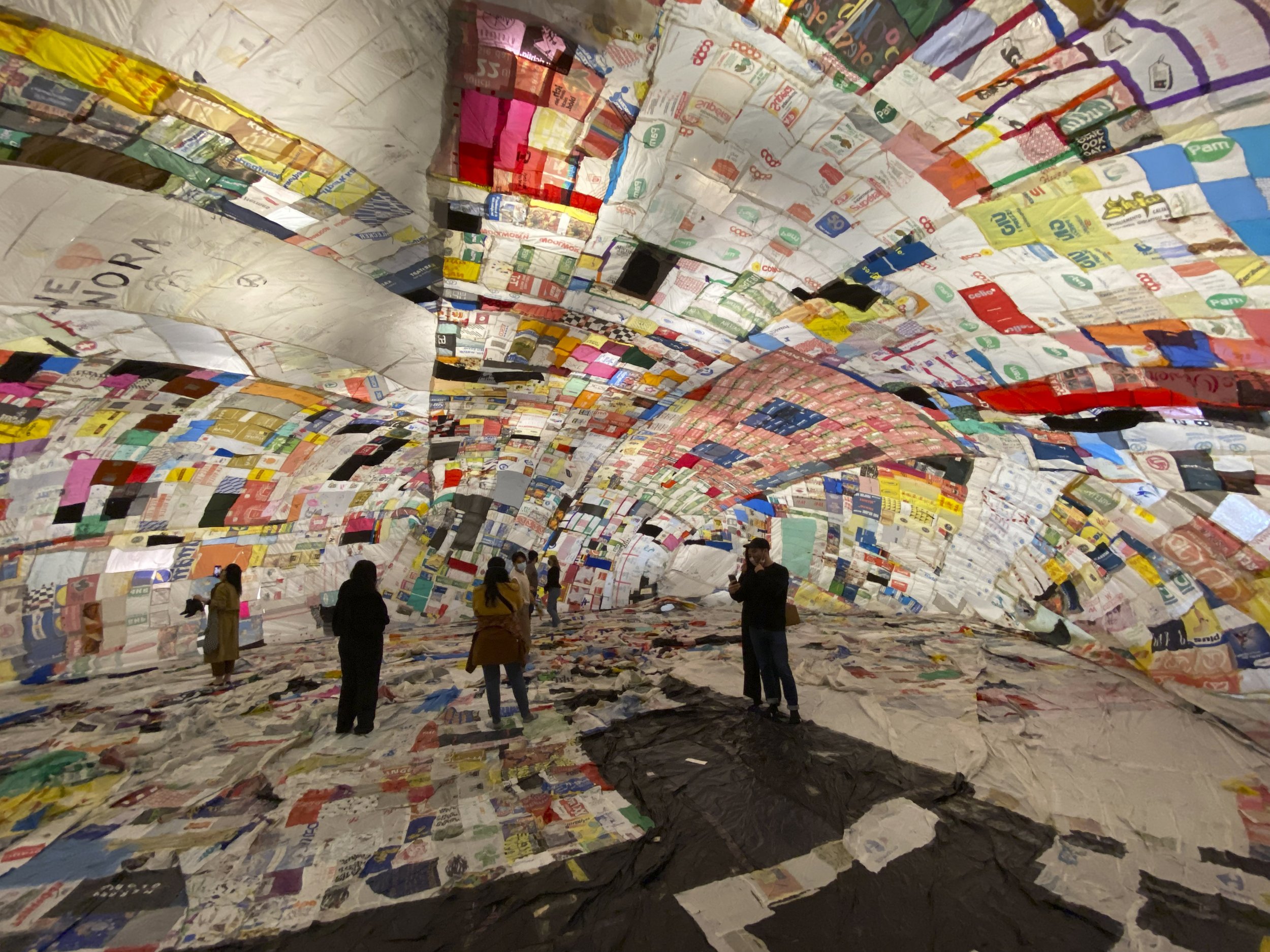
The exhibition documentation got a little clunky as it strove to unite a few themes - spiders, air pollution particulate matter, climate change, a giant hot air balloon made of recycled plastic bags - but for me there were two threads which ran throughout the show. The first was a sideways, original look at network theory. In his animal collaborators, Saraceno engaged the world’s undisputed experts on networks, but he also brought one of humanity’s more prominent theorists into the exhibition via a carefully placed book open on an excerpt by Bruno Latour (see below). Latour’s writing refers to a 2008 Saraceno piece which combines networks and spheres. For Latour this helps us visualise how a transparent interconnected network also comprises opaque, self-contained spheres, and those spheres connect/affect each other to different degrees, a phenomenon he illustrates by surreptitiously shaking Saraceno’s piece. These ideas are neatly brought together in the final exhibit in Particulate Matter(s), an immersive, monochrome, shadowy room full of globes and lines (see image below).

The second theme is one I only really understood a few days later when seeing the powerful Poetic Justice exhibition on at the New Mexico Museum of Art. Saraceno offers us hope - alongside a set of more negative emotions including fear, anger, poignancy and frustration at the impending climate and biodiversity twin emergencies. He does this most obviously through the final, technicolour exhibit Aerocene PM2.5, a fully recycled hot air balloon which floats through the warming power of the sun and a concentration of black carbon (PM2.5) in the balloon (see image). I’m not sure of the practicalities of this - indeed perhaps these aren’t relevant, because most importantly it is a positive attempt to reimagine the energy/transport status quo. But more broadly the theme of interspecies collaboration running through the exhibition is an exciting, provocative and inspiring vision for us to move out of our current human-caused plight.
I am the Wellcome Trust sponsored Clore 16 Fellow. In 2022 as part of this Fellowship I travelled to New York, Santa Fe and Los Angeles. I met an artist in New York thinking about criminal justice by using shape, the artist-led entertainment space innovating how audiences engage with evidence, and the climate team in the New York City Government who brought artists in to transform the cuture of the workplace. Read about them and others here.

In Clore Fellowship: USA Tags tomas saraceno, spiders, interspecies collaboration, Capitalocene, webs, networks, Bruno Latour, Particulate Matter, The Shed, New York
← Art at the New York Mayor's Office for SustainabilityMerz style political ceramics with Kahlil Robert Irving →

Latest Posts

Featured
Evaluating Glass House (Article 6/6)
October 25, 2022
Evaluating Glass House (Article 6/6)
October 25, 2022

Reviewing the impact and value of the September 2021 Glass House exhibition as an examination of art and policy and a case study of practice-based research

Read more →
October 25, 2022
Art about bureaucracy relating to art, New York
July 11, 2022
Art about bureaucracy relating to art, New York
July 11, 2022

An interview with the artist Julia Weist who has explored the relationship between art and bureaucracy whilst working as an artist in residence in the New York City Government

Read more →
July 11, 2022
Public records, NYPD surveillance, performance art
May 27, 2022
Public records, NYPD surveillance, performance art
May 27, 2022

An interview with Kameron Neal, a Brooklyn based artist who is working with the New York City government to reclaim and repurpose NYPD’s pervasive and invasive surveillance footage from the 1950s-90s.

Read more →
May 27, 2022
Meow Wolf, evidence, policy
May 13, 2022
Meow Wolf, evidence, policy
May 13, 2022

What can people involved in evidence and policy learn from a neon soaked arts-led entertainment space in the New Mexico desert? I visited Meow Wolf to find out.

Read more →
May 13, 2022
Art at the New York Mayor's Office for Sustainability
May 4, 2022
Art at the New York Mayor's Office for Sustainability
May 4, 2022

Interview with Janet Zweig, a New York based artist who is part of the NYC Public Artist in Residence programme and worked with the then Mayor’s Office for Sustainability, where a key contact was Kate Gouin, who also kindly made time for a discussion.

Read more →
May 4, 2022
Interspecies collaboration with Tomas Saraceno
April 25, 2022
Interspecies collaboration with Tomas Saraceno
April 25, 2022

Interspecies collaboration with Tomas Saraceno at The Shed gallery in New York

Read more →
April 25, 2022
Merz style political ceramics with Kahlil Robert Irving
April 23, 2022
Merz style political ceramics with Kahlil Robert Irving
April 23, 2022

Some notes from an impromptu visit to Kahlil Robert Irving’s show at the New York Museum of Modern Art (MoMA).

Read more →
April 23, 2022
Artist Melanie Crean, shape and NYC criminal justice
April 23, 2022
Artist Melanie Crean, shape and NYC criminal justice
April 23, 2022

Interview with Melanie Crean, a New York based artist who is part of the NYC Public Artist in Residence programme, working at the intersection of architecture, criminal justice and shape.

Read more →
April 23, 2022
Lability, transference, activation energy: conceptualising the impact of art in policy (Article 5/6)
February 14, 2022
Lability, transference, activation energy: conceptualising the impact of art in policy (Article 5/6)
February 14, 2022

Artists and funders often ask how artwork can have a policy impact. This article sets out thoughts with reference to three scientific concepts: lability, transference and activation energy.

Read more →
February 14, 2022
THE ART-POLICY MATRIX II (ARTICLE 4/6)
May 13, 2021
THE ART-POLICY MATRIX II (ARTICLE 4/6)
May 13, 2021

This article, the fourth in a series on the role of art in policymaking, situates real life artworks in a theoretical art-policy matrix. It starts by describing two case studies - Blue Planet II and The Museum of Extraordinary Objects - in more detail, before outlining nineteen other artworks, all which, in some way, link to policy.

Read more →
May 13, 2021

© Stephen RG Bennett
Subscribe · Portfolio